21/10/2026 01:01
Which Pieces Come Together? Telegram Photo Albums for Cambodian Door-Handle Shops

A door-handle photograph can look attractive while leaving the buyer’s main question unanswered: which pieces actually come together? A close-up might show one lever, while the caption mentions a set and a later photograph includes a latch sold separately. For Cambodian hardware shops promoting products through Telegram, that ambiguity creates unnecessary conversations and incorrect expectations. A carefully planned photo album can present the offer as one understandable group. This guide explains how to choose the pictures, check their sequence, describe the package and prepare a useful enquiry route. It also explains why an SMM panel’s post-view service cannot establish that viewers understood the offer or intend to buy.
1. Give each album one buying question
Start with a question narrow enough to answer visually. For a door-handle shop, useful questions include what comes in the package, how two finishes differ, or which details a buyer should photograph before asking about a replacement. Pick one. Combining new arrivals, installation examples and clearance offers in the same album makes it harder to know which caption applies to which product.
Consider a hypothetical shop in Phnom Penh preparing an album for a satin-finish lever set. Its purpose is to explain the contents of that particular package. The owner sets aside photographs of a black lever, an unrelated lock and an attractive completed doorway. Those images may be useful elsewhere, but they introduce different products or imply inclusions that the shop has not confirmed. The album succeeds when a viewer can identify the offer without reconstructing it from several conversations.
2. Choose an album when the pictures belong together
Telegram’s official album announcement explains that multiple photos or videos can be grouped into albums containing up to ten items. Senders can control photo order, and selected photographs display sequence numbers. The announcement also describes grouped media producing one notification instead of separate notifications for every item. These features make an album useful for complementary views of the same product.
The maximum is a limit, not a target. Use only pictures that answer different questions. A single photograph may be enough for a straightforward stock notice. Separate posts are usually clearer when products have different prices, availability or enquiry instructions. For the hypothetical lever set, four purposeful photographs are more useful than filling every available position with nearly identical angles. Choose the format according to the information buyers need, rather than the number of images available in the camera roll.
3. Build a shot list around package contents
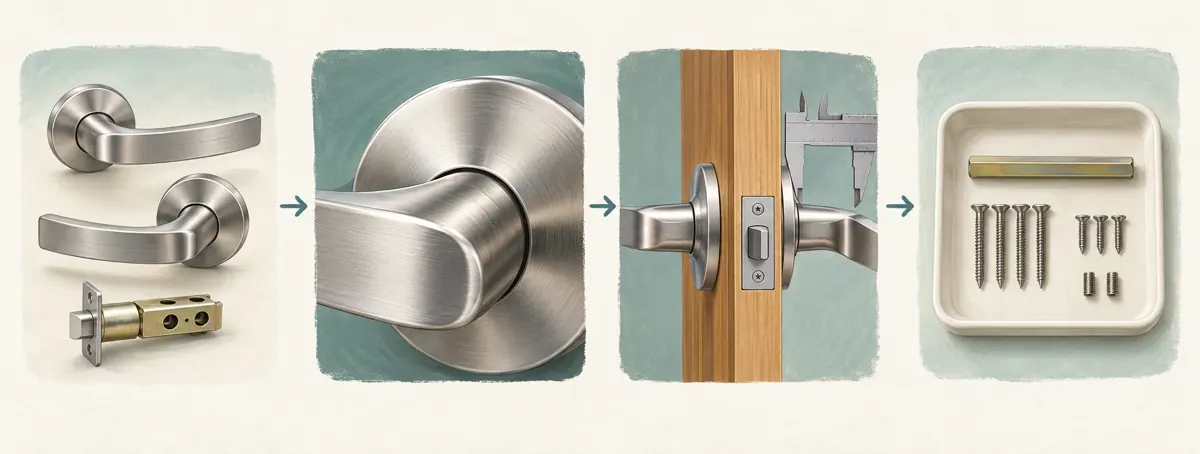
Begin with an overview showing the actual components included in the offer. Next, photograph the finish and handle shape closely enough to distinguish them. Add a side or rear view if it reveals a feature that matters to identification. Finish with the supplied accessories arranged clearly. Before photographing, ask the stock handler to verify that every displayed component belongs to the same package.
Keep measuring tools, display stands and optional accessories visually separate from sale items. If a ruler appears, make the relevant scale readable and state the unit in the caption. Avoid treating an illustrated measurement as a compatibility guarantee. Replacement hardware may require additional checks against the existing door and lock. For this article, the generated illustrations explain the editorial workflow; a shop’s actual offer should use photographs of its verified stock, with its own accurate measurements.
4. Keep finishes and variants consistent
Photograph one confirmed variant at a time. A polished handle in the overview and a satin handle in the detail image can make an honest offer confusing. Place a small internal reference card beside the shooting area, then check the selected files against that reference before uploading. The card need not appear in the published pictures; its purpose is to prevent staff from mixing similar products.
Use reasonably consistent lighting and backgrounds so a change in illumination does not look like a different finish. Avoid filters that materially alter the metal’s appearance. If two finishes are the subject of a comparison album, identify each explicitly and explain whether the package contents differ. For Cambodian buyers arranging collection through someone else, a clear product code is particularly practical: the person collecting can repeat it instead of trying to describe a subtle colour difference.
5. Write a shared caption that defines the offer
Write the caption before selecting the final photographs. Include the product reference, finish, confirmed contents, important exclusions and a specific next step. If publishing a price, state whether it applies to one component, a pair or a complete package, and identify the currency. Keep availability and collection information accurate. A photograph should support these statements, not silently expand them.
A hypothetical caption might read: “Model H-Satin. The photographed package includes the matching lever pair and the accessories listed below. Installation is separate. For a replacement enquiry, send the product code and clear photographs of your existing handle and door edge. We will check the details before confirming suitability.” Replace this sample with verified contents and an actual contact route. Use the language your customers understand, while keeping product references consistent across staff replies.
6. Check caption placement and viewing order
Telegram’s technical documentation distinguishes a shared album caption from captions attached to individual photographs. It states that an album caption should display when exactly one photo in the group carries a caption; when several have captions, those captions appear with the individual photos in detail view. For a simple package offer, one shared caption is therefore a sensible starting point. Check the result in the app your team uses.
Select the overview first, followed by detail images in the order a buyer is likely to need them. Review the numbered selection before sending. Then open the album in a private review conversation and inspect both the grouped view and individual pictures. Confirm that the package explanation is easy to find. Menu wording and presentation can differ between clients, so rely on a visual check of the finished draft rather than memorising one device’s button positions.
7. Run a buyer test before promotion
Ask a colleague who did not prepare the album to view it on a phone. Give them three tasks: identify the offered variant, explain what is included and describe how to ask about a replacement. Do not explain the answers first. Their uncertainty exposes missing information more effectively than asking whether the pictures look good. Record the specific point of confusion and change the relevant image or sentence.
Also check whether small accessories remain distinguishable when a photograph is opened. An overview can be attractive in the grouped layout while hiding the detail needed to understand the package. Test the intended public post link after publication and before sharing it elsewhere. If the link opens a particular media item, inspect the surrounding album and caption from that entry point. The destination should still make sense to someone arriving without earlier channel context.
8. Decide whether an SMM service fits the objective
The supplied public catalogue includes “Telegram - Post Views ~ 1 post ~ 𝐍𝐎 𝗥𝗘𝗙𝗜𝗟𝗟 ~ 100k/days ~ INSTANT”. Its name identifies a Telegram post-view offering, but no supporting description was supplied. The timing and refill wording should be treated as catalogue labels requiring clarification, not independently verified promises. The listing does not establish how an album is handled or whether a particular media link is accepted.
Before considering a request, ask what exact target is supported and how delivery is defined for grouped media. Do not infer that one order covers every picture because Telegram displays them together. If the objective is local enquiries about replacement hardware, purchased views cannot demonstrate Cambodian viewers, genuine interest, sales or ad delivery. Consider whether clearer product information and relevant, permission-based sharing address the objective more directly. An SMM panel listing is not evidence of official Telegram affiliation.
9. Give enquiries a practical next step
A useful album ends with a request the buyer can fulfil. For a replacement question, ask for the album’s product reference and the specific photographs needed for an initial assessment. Explain that the shop will confirm any further measurements before recommending a part. Avoid a vague instruction such as “send details”, which leaves customers guessing and often produces another photograph of the same front view.
Keep the first request proportionate. A buyer asking whether a matching finish exists does not need to provide a delivery address. Request collection or delivery information when it becomes relevant, through the shop’s intended private contact route. For customers outside the shop’s town, distinguish an initial product discussion from a confirmed shipment. The album can start the conversation, but staff still need to verify stock, suitability and fulfilment arrangements before making a commitment.
10. Review misunderstandings before repeating the album
Keep a short record of questions prompted by the post: whether the latch is included, whether the price covers both handles, or whether a finish matches the overview. These are editorial signals. If several conversations expose the same ambiguity, revise the content before sharing it again. Do not assume that more distribution will resolve a missing package explanation.
Maintain any service delivery record separately from the enquiry log. A service status documents what the provider reports; a buyer’s message documents a particular question; a confirmed order documents a separate business event. Avoid presenting one as proof of another. Before reusing the album, recheck its stock details and images. If the package changes, prepare a clearly updated offer and correct outdated information where practical so staff do not keep circulating a familiar but inaccurate post.

Frequently asked questions
Should every photograph have its own caption?
Not necessarily. For one package with several supporting views, a shared caption usually keeps the offer easier to follow. Telegram’s technical documentation describes different display behaviour when multiple items carry captions. If individual captions are essential, inspect each image in detail view and ensure important exclusions are not hidden from someone reading only the grouped preview.
Can I put several door-handle models in one album?
Yes, but give the album a clear comparison purpose. Identify each model and explain differences in contents or availability. If each product needs a separate price explanation and different ordering instructions, separate posts may be easier to understand. Avoid making readers infer which conditions apply from the position of an image.
Does a clear photo prove that a replacement handle will fit?
No. Photographs can help identify a product and collect preliminary information, but suitability may depend on measurements and details that are not visible. State what remains to be checked. Staff should confirm those details using reliable product information rather than turning a visual resemblance into a promise.
Will one Telegram post-view order cover the whole album?
The supplied service description does not answer that question. Ask the provider which exact link it accepts and what it treats as the delivery target. Do not submit several orders simply to compensate for uncertainty. Resolve the scope first, and keep the provider’s answer with any subsequent request.
How can a small shop judge whether the album is useful?
Review whether customers can identify the package and supply the information needed for the next conversation. Note recurring misunderstandings and revise them. A reduction in repetitive clarification can be useful operational evidence, but do not invent a percentage improvement or attribute sales to the album without an adequate basis. Visible views alone cannot establish understanding.
Explore the current service catalogue, create an account, or ask a specific question through support tickets.
- Telegram: Albums, Saved Messages and Better Search
- Telegram API: Uploading and Downloading Files — Albums and Grouped Media
Prepared with AI assistance. Illustrations explain the workflow and do not represent customer results.