22/10/2026 20:11
Which Class Times Can People Attend? Telegram Multiple-Answer Polls for Cambodian Pottery Workshops

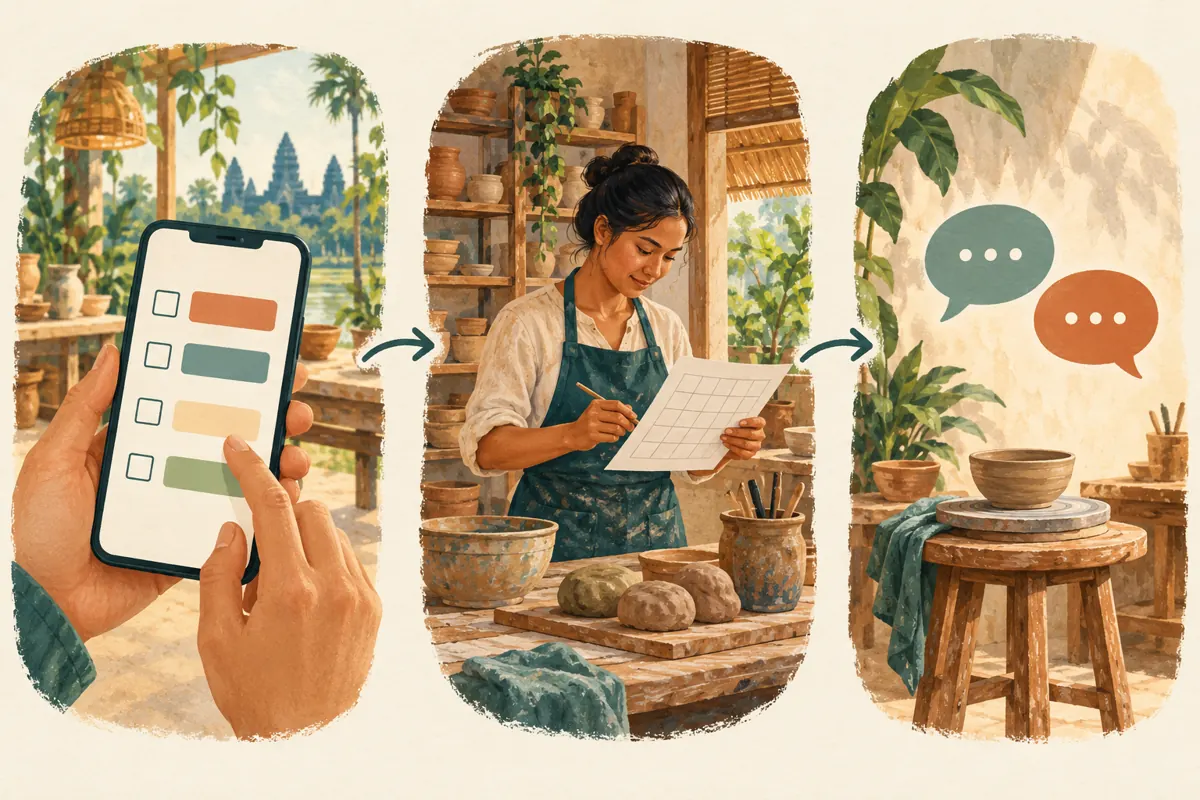
A popular pottery demonstration can attract attention without telling the owner when anyone can attend a class. Asking followers to choose their favourite session also leaves a gap: someone who prefers Sunday might still be available on Saturday. For a Cambodian workshop deciding when to open a beginner session, that flexibility matters. A Telegram multiple-answer poll can collect possible attendance times before the business commits to a timetable. The useful workflow is to define the class, ask about availability, check operational feasibility, and then invite individual bookings. Throughout that process, keep poll selections, promotional activity and confirmed reservations in separate records.
1. Ask about availability before asking about preference
Start with the decision the workshop actually needs to make. If the question is which session could work for the largest group of interested learners, ask people to select every time they could realistically attend. A favourite-time question answers something narrower. Mixing these questions can make a workable session appear unpopular simply because it was nobody's first choice.
Consider a hypothetical pottery studio in Phnom Penh planning one beginner bowl-making class. Its owner can teach on Saturday morning, Saturday afternoon or Sunday morning. A learner might accept both mornings but prefer Sunday. Multiple selections preserve that information. This is a planning example, not evidence of demand at any real studio, and a selection still does not reserve a seat.
2. Fix the class details that affect an answer
Before writing the poll, prepare a short class brief covering the workshop location, lesson language, duration, beginner requirements and what participants will make. Explain whether firing, glazing and later collection are included. State the actual confirmed fee and currency in the real announcement. Someone cannot give meaningful availability if they imagine a free demonstration while the owner intends a paid practical lesson.
Keep these conditions the same across the proposed times. If one option includes glazing and another does not, the results combine timetable preference with product preference. For Cambodian readers, give a recognisable area and clear arrival information instead of assuming everyone knows the shop. Ask a colleague to check the Khmer version of the invitation if that is the language learners use.
3. Build a small set of genuinely possible sessions
Check the teacher, benches, clay preparation and cleanup time before offering any slot. Avoid adding an attractive evening session merely to make the poll look comprehensive if staff cannot support it. A short list of feasible options is easier to interpret than a long list containing speculative possibilities.
Write each option with a full date and a start and finish time. Specify Cambodia local time in the accompanying brief. In a hypothetical draft, the labels could follow the pattern 'Saturday, [full date], 09:00–11:00' and 'Sunday, [full date], 09:00–11:00'; replace every placeholder before publication. Include 'None of these times' and tell readers to choose it only when no listed session works. Invite alternative suggestions separately so they do not become unreviewed promises.
4. Configure and test the Telegram poll
Telegram's official Polls 2.0 guide explains that polls support multiple answers and can be created in groups or channels through the attachment menu. Create a regular poll, enable multiple answers, and use a question such as 'Which beginner pottery sessions could you attend? Select every workable time.' Leave quiz mode off: scheduling has no correct answer.
Review the available anonymity settings before posting. Telegram distinguishes anonymous polls from polls with publicly visible voters. Explain the chosen setting to participants, and do not imply that visible voting proves identity or attendance. Test the draft in a staff group using the app your team actually uses. Check that multiple selections work and that the dates remain readable on a small screen. Menu wording can vary, so verify the controls rather than relying on a memorised sequence.

5. Invite responses from people who could attend
Publish the class brief immediately alongside the poll. Explain who the session is for and give a response deadline with a full date and local time. Say explicitly that voting helps choose the timetable and does not book a place. This prevents a friendly invitation from becoming an accidental promise to everyone who taps an option.
Share the invitation through relevant existing customer conversations or community spaces where promotion is welcome. A short demonstration can show the kind of activity learners will try, while the accompanying message explains the venue and commitment. Avoid asking unrelated audiences to vote merely to increase the total. Responses from people unable to travel to the workshop can make a session look practical when it is not.
6. Keep purchased poll votes out of the decision
The supplied SabySMM catalogue includes the exact public service name 'Telegram - Poll Vote ~ INSTANT'. Its label identifies a poll-vote service, but the supplied description is empty. There is no supporting detail here establishing voter location, attendance intentions, delivery conditions or suitability for workshop research. The word 'INSTANT' in a listing is not an independently verified delivery promise.
Do not order votes for a poll that will determine a real class schedule. Purchased engagement is not evidence of genuine interest, sales, ad delivery or Cambodian users. Adding it would make the availability results less useful. For an SMM-panel customer, the sensible decision in this scenario is to exclude the research poll from service requests and spend effort on reaching relevant people with a clear invitation.
7. Read each option without adding overlapping audiences
Multiple-answer results require a different interpretation from a single-choice vote. One participant can appear under several session options. Adding those option totals therefore does not tell you how many different people want classes. Similarly, two well-supported times do not automatically justify running two sessions: the same flexible learners may account for much of both groups.
Review each feasible slot on its own, then decide which one to offer first. Treat an anonymous poll as an availability signal, not a customer list. Silence also has several possible meanings: a reader may have missed the post, lack enough information or be uninterested. Record what the poll actually shows and leave those explanations as possibilities. Do not present the result as a survey of Cambodian consumers generally.
8. Close the survey and make an operational decision
Telegram's technical documentation defines a closed poll as one that no longer accepts answers. At the announced deadline, close voting using the available poll controls and preserve a dated result record. Keep the question and class brief with it. Results without their original conditions are easy to misread later, especially if the fee or venue changes.
Choose among the workable options using both responses and delivery constraints. In a hypothetical tie, the owner might favour the session with confirmed teaching cover and enough preparation time. Explain that reasoning briefly rather than claiming the audience selected something it did not. If no option supports a sensible next step, ask one focused follow-up question or postpone. Do not keep adding invitations until the numbers resemble a predetermined answer.
9. Turn the selected session into a separate booking offer
Publish a fresh announcement naming the selected session and restating the location, duration, fee, inclusions and booking deadline. Give one clear contact route. Ask interested learners to confirm the session and number of places they need privately. A poll cannot reliably tell you whether one account represents one learner, a couple or someone asking on behalf of a friend.
Use a booking record with distinct states such as enquiry received, details agreed and place confirmed. Apply the workshop's actual payment and cancellation terms consistently, and explain when a reservation becomes final. Never mark everyone who selected the winning time as booked. If confirmed demand exceeds capacity, offer a waiting list with permission rather than promising another class before staff and materials are available.
10. Correct mistakes without rewriting what the poll meant
A common mistake is changing the class conditions after collecting answers. A different venue, longer lesson or higher fee can invalidate the original availability signal. Publish the change clearly and obtain fresh confirmation. If a date was wrong, identify the affected poll and replace the question where necessary; do not quietly interpret its answers as approval of a corrected date.
Another mistake is allowing the schedule announcement to imply customer proof. Avoid claims such as 'fully booked by popular demand' unless the booking record supports them. Report outcomes using ordinary, accurate language: a time was selected, reservations are open, or the class is confirmed. For the next planning cycle, compare the questions people asked with the information in the invitation. Improve missing details before assuming that a larger poll would solve the problem.

Frequently asked questions
When is a single-answer poll more appropriate?
Use a single answer when you deliberately want one preference per person, such as choosing a favourite theme for a future demonstration. For scheduling, multiple answers usually preserve more useful flexibility. If you need both availability and preference, ask them separately and explain which answer will guide the decision. Otherwise participants may select only their favourite time despite being free for others.
Does the option with the most selections have to become the class time?
No. The poll supplies one input to a business decision. Teacher availability, preparation time and suitable space still matter. Explain beforehand that the workshop will confirm the final timetable after reviewing responses. If the leading option becomes impossible, acknowledge the constraint and offer a realistic alternative without implying that respondents already accepted it.
Can an anonymous poll be used to reserve places?
It should not serve as the reservation record. You still need a way to confirm who is attending, how many places they need and whether they accept the class conditions. Keep that information in a private booking conversation or appropriate booking system. Publicly visible votes would not remove those requirements either; a selected option is still only an answer to the poll question.
What should the workshop do if someone already purchased votes?
Treat the affected poll as unsuitable for estimating customer availability. Keep an internal note explaining why, and avoid presenting its totals as genuine demand. Ask interested learners to confirm workable times directly or run a fresh survey protected by clear team instructions against purchased votes. Do not subtract an assumed quantity and claim that the remainder represents verified prospective attendees.
How should an owner respond when very few people vote?
First check whether the invitation gave enough information to decide: location, fee, duration and exact dates. Then ask a small number of genuinely interested customers whether the proposed options are workable, without pressuring them to participate. A quiet poll may justify a smaller trial or postponement. It does not justify buying responses or claiming that the workshop has demonstrated market demand.
Explore the current service catalogue, create an account, or ask a specific question through support tickets.
- Telegram: Polls 2.0 — Visible Votes, Multiple Answers, and Quiz Mode
- Telegram API: Poll constructor and closed, public-voter and multiple-choice settings
Prepared with AI assistance. Illustrations explain the workflow and do not represent customer results.